When Home Patch Testing Isn't Enough
The seven-to-ten-day arm checks one product. A dermatologist's patch test looks for the allergen. They are different tests with different jobs.
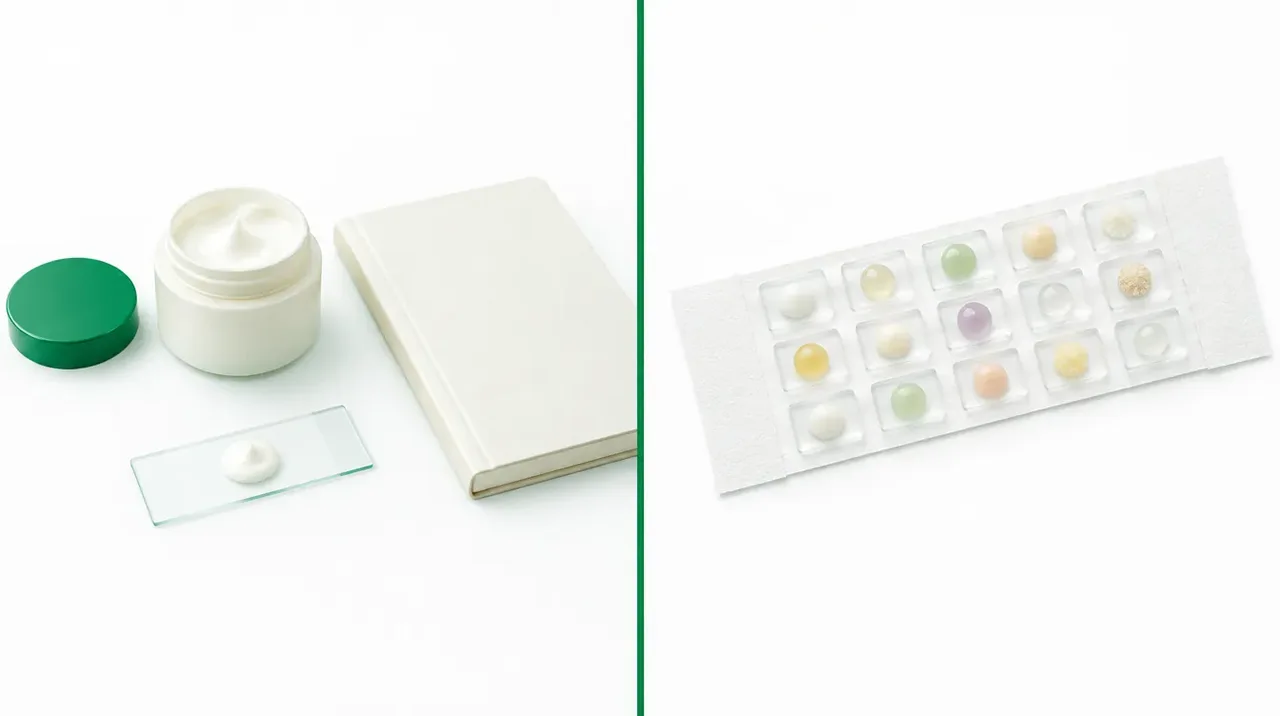
You did everything right. The seven-to-ten-day arm, one product at a time, a little note on your phone. The serum passed. The cream passed. And your eyelids are still red and itchy, your face has filed another complaint, and the list of “things I’m allergic to” on your phone now runs to fourteen ingredients, three of which appear in the moisturizer you’ve used happily for years.
This is where the home test runs out of road. It was never built to find an allergen. It was built to audition one product. This guide shows what each test can actually tell you, why a dermatologist’s patch test is a different instrument rather than a fancier version of yours, and when to stop testing on your arm and book one.
The short answer
| The seven-to-ten-day arm | Clinical patch testing | |
|---|---|---|
| What goes on | One whole product, all its ingredients at once | Individual, standardized allergens, each in its own spot |
| Where | Inner arm or elbow | The back, under occlusion |
| Who reads it | You | A trained clinician |
| What it answers | “Does my skin tolerate this product, here, now?” | “Which substances am I allergic to, and do they matter for me?” |
| Can it name the allergen? | No | That is its job |
| Can it rule out allergy? | No | Within the allergens tested, it is the gold standard |
The American Academy of Dermatology’s home method is a quarter-sized spot on the inner arm, twice a day, for seven to ten days [1]. It is a good habit and I’d defend it to anyone. The same page is also clear about its limit: if you can’t work out which ingredient is irritating you, talk to a board-certified dermatologist, who may recommend patch testing [1].
What the arm can and can’t tell you
The arm tests a mixture. A serum might carry thirty ingredients; if your arm goes red, all thirty are suspects, and the one you blame will usually be whichever you’ve read the scariest article about. That is how a list of “allergies” gets written by coincidence and never put on trial.
The arm also can’t clear anything. A product passing on your forearm doesn’t mean its ingredients are safe on your eyelids, which are thinner and much quicker to complain. It doesn’t mean the same ingredient will behave in a different formula, at a different strength. And a clean week doesn’t settle it either: allergic contact dermatitis can take days to show up, and repeat exposure matters. In the original study of the repeated open application test, the clinic’s formal version of the arm test, 86 patients with contact dermatitis applied substances twice daily for a week, and 44% of those with a questionable standard patch test turned positive [5]. That is a tool clinicians use alongside patch testing, not instead of it, and it was read by people who knew what they were looking at.
None of this makes the home test useless. It catches the obvious losers before they reach your face. It just answers a smaller question than most people ask it.
What clinical patch testing actually is
Patch testing looks for delayed, skin-level allergy: the type IV reaction behind allergic contact dermatitis. It is not the same as the prick or intradermal tests used for hay fever, hives or food allergy, which look for a different kind of reaction altogether [2].
According to the American Contact Dermatitis Society, it usually takes three office visits over about a week. Individual allergens are taped to your back under occlusion at the first visit. They stay on for two days, then come off for a first reading. The final reading happens three to seven days after placement, and each spot is checked for redness, swelling, scaling and blisters [2]. Then comes the part a home test can never do: the clinician matches each positive to your history and your actual products. The ACDS notes that this final visit can run 60 to 90 minutes and often involves going through the ingredient lists of everything you, and sometimes your partner, use [2]. The ACDS also notes that history alone is not enough to diagnose allergic contact dermatitis in most cases [2], which is a polite way of saying your phone list is not a diagnosis.
The European guideline on patch testing covers the details that make results reliable, from materials and technique to individual factors that can affect the outcome and how to test materials patients bring in [6]. Your clinic will tell you what to stop or avoid beforehand. Ask them, rather than a forum.
Why the size of the panel matters
Here’s a fight worth picking: a patch test is only as good as the allergens on it. The commonly available 35-allergen T.R.U.E. TEST is a reasonable start. But the ACDS reports that it at most detected 66% of the clinically relevant reactions found by a 70-allergen screening series from the North American Contact Dermatitis Group, and that comprehensive testing typically uses somewhere between 65 and 200 allergens chosen around your history and exposures [2]. In a 2025 call to action in the Journal of the American Academy of Dermatology, the society argued for broad access to that kind of comprehensive patch testing rather than screening alone [3].
Personal care products make the case for them. A 2026 review lists fragrances, botanicals, preservatives, surfactants, emollients, emulsifiers, vitamins and UV filters among the allergenic ingredients, and warns that traditional panels often miss newer ones, naming limonene and linalool hydroperoxides, sodium benzoate, octocrylene and benzophenone-4 [4]. Note the botanicals. The soothing aisle is not exempt. The review also recommends targeted series and repeated open application tests to improve accuracy, and stresses teaching patients to read labels afterward [4].
So “I’ve been patch tested and it was negative” deserves one follow-up question: tested with what? If your reactions continue, it is reasonable to ask whether a more extended series, or testing with your own products, makes sense.
The worry budget
| Worth a worry | Not worth a worry |
|---|---|
| Reactions that keep happening after you’ve stopped the obvious suspect | One product that failed the arm test and never caused trouble again |
| A rash spreading beyond where any product touched | The arm “only” testing one product; that is its job |
| Eyelid, lip or hand dermatitis that won’t settle | Not knowing the allergen after a single, cleared reaction |
| A growing list of “allergies” nobody has tested | Being one of many: about 20% of the general population has at least one contact allergy [7] |
| A screening panel came back negative but the rash didn’t | The week of visits; it is shorter than another season of guessing |
When to stop testing at home and book
- The same kind of reaction keeps coming back, even after you’ve dropped the product you suspected.
- You’ve failed the arm test with several products and can’t see what they share.
- The reaction spreads past where the product went, or turns up somewhere surprising: eyelids, lips, neck, hands.
- It lasts. Irritation usually settles within days of stopping. A rash that doesn’t settle needs someone qualified to look at it.
- Your avoidance list is growing faster than your routine. If you’re cutting whole categories on suspicion, you need answers, not more guesses.
- It’s affecting work or sleep, or involves materials at work you can’t simply stop touching.
Before the appointment: ask the clinic what to pause beforehand. Bring the products you use, the ones you suspect, and their ingredient lists, plus photos of the reaction at its worst. Keep the phone log; it’s genuinely useful as history, as long as nobody mistakes it for results.
Exit plan while you wait: stop the newest product, wash any reacting area gently with lukewarm water, don’t reapply, and don’t add a soothing balm, serum or oil to the bill. Give your skin a few calm days and change nothing else. If it isn’t improving, or it’s getting worse, don’t wait for the booking: see a clinician sooner.
An illustrative example
This is a hypothetical case, used only to show the method. Dana’s eyelids flare every few weeks. She has arm-tested five products since spring; two failed, three passed. Her phone list of suspects now includes “fragrance”, “plant extracts” and “anything with an E number”. The two failures share a fragrance and a preservative. So does her shampoo, which she never thought to suspect because she rinses it off. A home test can’t sort that out. A dermatologist can test the fragrance and preservative separately, alongside other common allergens and, if they think it useful, her own products. Whatever comes back positive becomes the line on the rider. The rest of her list can go.
Common mistakes
- Treating a passed arm test as an all-clear for an ingredient everywhere on your body.
- Treating a failed arm test as a diagnosis of whichever ingredient sounds worst.
- Swapping to “hypoallergenic” products instead of finding out. The word is not a standard; see what “hypoallergenic” does and does not tell you.
- Forgetting the rinse-offs, nail products, hair products and anything your partner uses that touches your face.
- Assuming one negative screening panel ended the question when the rash is still there.
Practical steps
- Keep using the home method for new products. It’s still the right first screen.
- Introduce one new thing at a time so any reaction has one suspect, not five.
- If you suspect fragrance, learn the difference between fragrance-free and unscented.
- If reactions keep happening, read how to identify the cause of contact dermatitis and take that history to a dermatologist.
When a home test is not enough. If you react to several products, if reactions keep coming back, spread beyond where a product touched, affect your eyelids, lips or hands, or you cannot work out the cause, see a dermatologist about clinical patch testing. It uses individual, standardized allergens under controlled conditions and is the only reliable way to identify a contact allergen. Seek urgent medical care for swelling of the face, lips or tongue, difficulty breathing, or a severe or rapidly spreading reaction.
Frequently asked questions
Can a home patch test tell me what I'm allergic to?
No. A home test puts a whole product, with all its ingredients, on one patch of skin. If it reacts, you know that product disagrees with you, not which ingredient did it. Only clinical patch testing with individual, standardized allergens, read by a trained clinician, can identify a specific allergen.
What happens at a dermatologist's patch test?
According to the American Contact Dermatitis Society, it usually takes three visits over about a week. Individual allergens are taped to your back under occlusion, removed after two days for a first reading, and read again three to seven days after they went on. The clinician then matches any positives to your history and the products you actually use.
My home test passed. Does that mean I'm not allergic?
It means that product, on that patch of arm, did not cause a visible reaction during the test. It does not rule out allergy to its ingredients in another product, on another part of your body, or later on. If reactions keep happening anyway, a dermatologist is the next step.
Is patch testing the same as an allergy skin prick test?
No. Patch testing looks for delayed, skin-level allergic reactions like allergic contact dermatitis. Prick and intradermal tests look for immediate allergies such as hay fever or food allergy. They are different tests for different conditions.
Sources and further reading
- American Academy of Dermatology, How to test skin care products
Home method: a quarter-sized spot on the inner arm or elbow, twice a day for 7 to 10 days. If you cannot identify the irritating ingredient, it advises talking to a board-certified dermatologist, who may recommend patch testing.
- American Contact Dermatitis Society, Statement on patch testing
Position statement (2018). Patch testing diagnoses delayed, type IV reactions such as allergic contact dermatitis and differs from prick testing; history alone is inadequate in most cases. Three office visits over one week: allergens on the back under occlusion for two days, final reading 3-7 days after placement. The 35-allergen T.R.U.E. TEST at most detected 66% of the clinically relevant reactions found on a 70-allergen NACDG series; comprehensive testing typically uses 65 to 200 allergens.
- Chen et al., The importance of comprehensive patch testing: A call to action from the American Contact Dermatitis Society
Journal of the American Academy of Dermatology 2026;94(4):1343-1345 (online November 2025). Letter from the ACDS arguing for broad access to comprehensive patch testing with a range of allergens, rather than limited screening alone.
- Smale, Karagounis, Milam, Cohen and Flamm, Allergic contact dermatitis to personal care products: A focus on established and emerging allergens
Journal of the American Academy of Dermatology 2026;95(4):1095-1102. Review: common allergens in personal care products include fragrances, botanicals, preservatives, surfactants, emollients, emulsifiers, vitamins and UV filters. Patch testing remains the gold standard, but traditional panels often miss emerging allergens such as limonene and linalool hydroperoxides, sodium benzoate, octocrylene and benzophenone-4; targeted series and repeated open application tests can help.
- Hannuksela and Salo, The repeated open application test (ROAT)
Contact Dermatitis 1986;14(4):221-227. 86 patients with contact dermatitis; twice-daily application to the forearm for 7 days. 44% of patients with a questionable patch test result were positive on ROAT.
- Johansen et al., European Society of Contact Dermatitis guideline for diagnostic patch testing: recommendations on best practice
Contact Dermatitis 2015;73(4):195-221. Covers patch test materials and technique, individual factors that influence results, testing of materials brought in by the patient, and final evaluation and counseling.
- Alinaghi et al., Prevalence of contact allergy in the general population: a systematic review and meta-analysis
Contact Dermatitis 2019;80(2):77-85. 28 studies, 20,107 people patch tested from the general population; pooled prevalence of contact allergy 20.1%, with nickel (11.4%) and fragrance mix I (3.5%) most common.
Sources checked October 24, 2026. This is an editorial summary, not a systematic review or individual advice.